

COMPRESSOR SPARE PARTS
As a buyer, being aware of the essential parts for a properly functioning of compressor is important.
SCREW COMPRESSOR SPARE PARTS

Rotary screw element
Drives the air to the outlet and creates the pressure.
WORKING:
Interlocking twin rotors are placed inside lined cylinders wherein their
complementary and circulatory rotations occur. As soon as the machine is
switched on, rotors will operate, receiving suctioned air from the opening
valve. Connected to the compressor’s motors, rotors will start spinning
through a wide distribution system of belts, bearings, and the motor drive.
Air is sucked and compressed between the rotors while the spinning
continues.
The air will be transformed to a fully compressed state once the grooves
will reach the finishing of the rotation length. Lastly, the compressed air will
be released through the discharge valve into the storage tank.

Compression chamber
Encloses the rotary screw element. It’s possible to have multiple stages for
more pressurization.
WORKING:
Interlocking twin rotors are placed inside lined cylinders wherein their
complementary and circulatory rotations occur. As soon as the machine is
switched on, rotors will operate, receiving suctioned air from the opening
valve. Connected to the compressor’s motors, rotors will start spinning
through a wide distribution system of belts, bearings, and the motor drive.
Air is sucked and compressed between the rotors while the spinning
continues.
The air will be transformed to a fully compressed state once the grooves
will reach the finishing of the rotation length. Lastly, the compressed air will
be released through the discharge valve into the storage tank.

Inlet suction air filter
Set at the inlet of the compression chamber where it’s possible to catch
and reduce dust, and ingress of damaging particles. Necessary for cleaning
and protection of the compressor stage/s.
WORKING:
These are required for regulatory maintenance and an important
component of a compressor. When it comes to oil-injected units, the air
filters clean up moisture and oil residue from the opening valve and cooling
injection processes. Regular inspection of air filters is crucial for your
equipment’s performance.
Air filters are located near the intake valves for the oil-free units. They form
the primary defense line from pressurized air impurities and are thus the
most common maintenance filters.

Oil filter
Oil Filters are set within the oil system to gradually remove contamination in
the oil that is used for lubrication or compression.
WORKING:
Oil filters help keep the compressed air’s gas purity clean and intact and
ensure proper lubrication and cooling functions of the entire machine. Belt
and pulley run in sync with those nestling within the oil separator. Also,
since contemporary oil filters have a spin on installation, they are easy to
assess and replace.
Most oil filters are equipped with bypass valves that send alerts when oil
filters are too jammed or internal operating temperatures are hot. They will
allow raw oil to infiltrate the compression chamber but without entering the
oil filters.

Anti-friction roller and ball Bearings
These secure the rotary screws, making sure they are balanced and rotate
evenly.
WORKING:
Bearings help in reducing friction, balancing part movements, regulating the
overall compressor’s temperature. Although there are several bearing
nested in crucial places, axial and radial-load bearings are the most
important among all. Radial-load bearings help ensure the compressor’s
smooth rotations and horizontal circular roller motions without creating
noises. Axial bearings keep the complementary and perpendicular spinning
of the rollers in load and balanced.

Suction valve or load / unload valve
This is usually set at the top of the compressing unit. Responsible for
drawing the raw air inward to be processed by the rotary screw element.
Opens fully when system pressure drops below the minimum set limit also
called as loading and closes the valves called as unloading when the
system pressure reaches the maximum set limit.
WORKING:
Suction valves get triggered by your machine’s programmed stage settings
to close and open, which ensures the efficiency of the rotary screw units.
As they are engineered to suit different design elements for maximizing
airflow, suction valves are available in different configurations. The poppet
valve, the ring valve, and the plate valve are the three types of suction
valves. Each of them has its distinct concentric layers to ensure ideal air
flows for specific operation types.

Discharge valve
This is usually set at the end of the compression process. It only opens
once the correct minimum pressure is achieved and ensures enough
pressure is maintained within the system to ensure good lubrication of the
compression stages.
WORKING:
Being the endpoint of your compressor system, the discharge valves offer a
safe and steady release of pure and fresh concentrated air. Whether the air
is released into the final storage tank or connected to the air hoses, the
discharge valve serves as the critical regulatory agent. Inspecting these
valves and their performance is important to avoid any kind of
malfunctioning.

Compressor motor
This drives the rotary screws and powers the unit’s compression cycle. It is
controlled by the compressor microprocessor controller.
WORKING:
It is important to remember that the bigger the motor the better the
performance does not always hold true for ensuring optimal productivity.
The horsepower generated and maintained by massive motors may court
efficiency problems.
You would want to test your motors frequently and check if it’s being
productive, thereby gauging the overall performance of your compressor.

System control
This takes the form of a display and input panel. Necessary for operating,
automating and monitoring the compressor unit.
WORKING:
A compressor’s system and stage control can regulate, monitor, and track
the machine’s performance by assessing functionality and checkpoints
throughout multiple unit features.
Particular unit designs may have internal sensors for automatically
powering off the motor upon the completion of a programmed cycle or
when the storage container is saturated. This is a smart technological
feature for high-capacity equipment pieces.

Separator vessel
This is a tank where compressed air is sent for separation of oil from
compressed air, it has dual use, its a reservoir for oil at the same time
holds air pressure with the aid of the min pressure valve to ensure
lubrication pressure is maintained within the system.
WORKING:
A compressor’s system and stage control can regulate, monitor, and track
the machine’s performance by assessing functionality and checkpoints
throughout multiple unit features.
Particular unit designs may have internal sensors for automatically
powering off the motor upon the completion of a programmed cycle or
when the storage container is saturated. This is a smart technological
feature for high-capacity equipment pieces.

Gaskets and seals
Necessary to maintain maximum pressure and make sure the overall
compressor is leak-free at critical points in the unit.
WORKING:
Gaskets and seals boast an air-tight design to prevent leakage of
compressed air. Chamber lining and bearing rings around compression
rotors and bearings are as critical as any other big or major compressor
parts. As they are oil-injected or self-lubricated, sliding seals reduce natural
friction building between rotors.

Non return valve / check valve
This valve ensures that when the compressor unloads or stops generating
air, it retains the pressure in the downstream system.
WORKING:
A non-return valve (NRV) or check valve is a mechanical device that allows fluid to flow in one direction only. They are also known as reflux valves, retention valves, foot valves, or one-way valves. Check valves have two openings, one for fluid to enter and one for it to leave. They are flow sensitive and open when the upstream pressure is greater than the seat release pressure

After cooler
This cools down the compressed air and removes the heat generated by
the compression process. The coolers can be either cooled by ambient air
or with water in water cooled compressors. Selection of either air cooling or
water cooling is made based on individual customer requirements and
location of the installation.
WORKING:
An aftercooler is a mechanical heat exchanger that cools hot compressed air from a screw compressor and removes condensation. This prevents moisture from building up in the compressor's pipe system and prepares the air for use in air-operated equipment or to enter a dryer. Aftercoolers can be water-cooled or air-cooled and typically come with automatic drainage and a water separator. Air-cooled aftercoolers use ambient air to cool the compressed air. Aftercooler units can lower temperatures to between 5–20°F immediately after the compressed air is released from the compression unit

Water separator
One of the critical screw air compressor components, the water separator
is installed downstream of the after cooler and separates liquid moisture
from compressed air and ensures air leaving the compressor is saturated
by free of any liquid water.
RECIPROCATING COMPRESSOR SPARE PARTS
Cylinders

Cylinders of the reciprocating compressor are used in the process industries are separable from the frame. They are attached to the frame by way of an intermediate part known as the distance piece. The cylinder will accommodate the both suction and discharge valve plates.
WORKING:
Reciprocating compressor cylinders, also known as compression cylinders or stages, are chambers that trap gas during the compression process. The piston moves back and forth in the cylinder to decrease the volume and increase the pressure of the gas.
Airpack

Piston
The piston is the heart of the reciprocating compressor. The piston translates the energy from the crankcase to the gas in the cylinder. In order to avoid the leakage of compressed gas between the piston and cylinder, the piston is equipped with a set of sliding seals called as piston rings. Usually, the rings are made of a material, that having self-lubricating property to reduce the slide friction force between the cylinder and the piston. This to avoid the wear in the cylinder wall and also increase efficiency by reducing the friction force.
WORKING:
The working principle of a reciprocating air compressor is to draw gas through an inlet, and then move the gas through a cavity or chamber that decreases in size. This compresses the gas and by doing so the gas within the chamber increases in pressure.

Piston Rod
The piston rod is threaded to the piston and transmits the reciprocating motion from the
crosshead to the piston.
WORKING:
The working principle of a reciprocating air compressor is to draw gas through an inlet, and then move the gas through a cavity or chamber that decreases in size. This compresses the gas and by doing so the gas within the chamber increases in pressure.

Distance Piece
The distance piece is a separable housing that connects the cylinder to the frame. The
distance piece may be open or closed and may have multiple compartments. It may be
furnished as single, double, or extra long.
WORKING:
The purpose of a longer distance piece is to isolate that part of the piston rod entering the crankcase and receiving lubrication from the part entering the cylinder and contacting the gas. This prevents lubricant from entering the cylinder and contaminating the gas, particularly necessary in non-lubricated cylinders. It can also keep a synthetic lubricant in a cylinder.

Rod Packing
Rod packing is required to prevent the gas leakage along the piston rod where it passes
through the crank end cylinder closure.
If cooling packing is required, the stuffing box may be jacketed for liquid coolant. The
packing rings are the heart of rod packing assembly.

Tangent Ring
The tangent ring is cut into three segments so that each cut lies on the side of an equilateral triangle. The cuts of this ring maintain sealing contact regardless of variations of the ring’s inside diameter. As wear occurs, the ring segments will close radially to compensate while still maintaining sealing contact at the tangential joints by mean of Garter Spring.

Radial Ring or
Pressure Breaker Ring
The radial ring or pressure breaker rings are cut into three segments so that each cut lies on the side of a radial direction of the ring. The cuts of this ring are used to break down the pressure act on the ring. Usually, a radial ring is the first packing ring face the cylinder
pressure.

Backup Ring
This type of ring construction is similar to radial ring. As the name indicate this type of ring is used to backup all the rings when using in the high-pressure application.

CrankShaft
Larger compressors, normally above 150 kW(200 hp), have forged steel crankshafts. for
compressor less than or equal to 150kW machines ductile iron crankshaft. Crankshafts should have removable balance weights to compensate for rotary unbalance as well as reciprocating unbalance. The crankshaft should be dynamically balanced when above 800 rpm.

Bearing
The main and connecting rod bearings should be split-sleeve, steel-backed, babbitted insert type. Antifriction bearing shall be used for compressor rating less than 150kW. As per API 618 trapper roller bearings are used as the main bearing for compressor rating less than 150kW.

Connecting Rod
The connection rod is used to connect the crankshaft and the crosshead. The connecting rod converts the rotary motion into reciprocating motion. The connecting rod bolts and nuts shall be securely locked with cotter pins or wire after assembly.
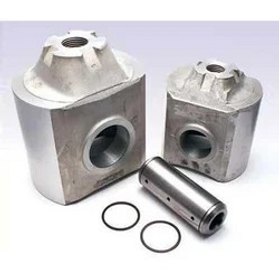
Cross Head
All industrial reciprocating compressors are equipped with Crosshead. The crosshead is used to guide the piston in the cylinder bore. The following are the advantage of crosshead. The compressor can use a narrow piston, due to the use of narrow piston larger valve area for greater efficiency.

Valves
The reciprocating compressor cylinder valves are of the spring-loaded, gas-actuated type.
CENTRIFUGAL AIR COMPRESSOR SPARE PARTS

Centrifugal Compressors Lubricants
Optimized lubricant is designed to provide the same superior performance over mineral oils that the industry has come to expect from premium lubricant manufacturers, Premium base stock provides exceptional performance, surpassing all mineral-based lubricants Extended operating life of three years (24,000 hours), reducing fluid disposal frequency and costs Eliminates deposits and build-up caused by fluid breakdown allowing bearings to run cooler, minimizing downtime and costs Superior film strength protects against metal-to-metal contact Stable viscosity over a wide temperature range protects compressors

Control Panels
A compressor control system consists of a compressor, motor, sensors for compressor protection and control, and a control panel. The control panel is a crucial component that coordinates the operation of the compressor and its components.

Valves
Centrifugal compressors are equipped with various valves that play a crucial role in their operation, safety, and efficiency

Bearings
Centrifugal compressors are equipped with various types of bearings to support the rotor and maintain its position within the stationary elements of the compressor.

Bullgears
Centrifugal compressors are a type of dynamic compressor that uses the kinetic energy of a spinning impeller to compress a gas. The bullgears play a crucial role in the operation of a centrifugal compressor.

Bypass & Blow-Off Valves
Bypass and blow-off valves are designed to improve the operation of centrifugal compressors. They play a crucial role in maintaining the compressor’s performance, efficiency, and longevity

Air Coolers
Centrifugal compressors use air coolers to dissipate heat generated during the compression process. Air coolers are an essential component of centrifugal compressor systems, as they help to maintain the compressor’s efficiency and prolong its lifespan.

Check Valves
Centrifugal compressors use check valves to regulate air intake and bypass air, which in turn regulates the air discharged and prevents surge. These valves play a crucial role in maintaining the compressor’s performance and efficiency.

Condensate Traps
A condensate trap is a crucial component in a centrifugal compressor system, designed to remove condensate from the compressed air stream. The purpose of the condensate trap is to prevent the accumulation of condensate, which can lead to issues such as oil and/or water collection, affecting filter efficiency, and potentially causing premature wear and catastrophic failure.

Couplings & Coupling Spacers
Couplings and coupling spacers play a crucial role in the operation of centrifugal compressors. They are designed to connect and separate the compressor components, allowing for smooth and efficient transmission of power.

Diffusers
Centrifugal compressors use a diffuser to convert the kinetic energy of the gas or fluid exiting the impeller into static pressure. The diffuser plays a crucial role in the performance and efficiency of the compressor. There are two main types of diffusers: vaneless and vaned diffusers.

Filter Elements: Air, Oil, Demister, Cannister, Spin-On

Gasket Kits: O-Rings Gaskets
Centrifugal compressors use a turbine or a centrifugal impeller to compress the gas by increasing the velocity of the gas and then reducing the volume. Common gaskets used in centrifugal compressors include spiral wound gaskets and PTFE gaskets.

Gerotors
A Gerotor is a type of impeller used in centrifugal compressors. It is a combination of a gear and a rotor, designed to increase the efficiency and performance of the compressor. The Gerotor impeller is typically used in high-speed applications, such as in turbochargers and superchargers, where high compression ratios and high flow rates are required.

Heat Exchangers
Centrifugal compressors are widely used in various industrial applications, including air conditioning, refrigeration, and power generation. One of the key components of a centrifugal compressor is the heat exchanger, which plays a crucial role in the compression process.

Impellers
Impellers are the heart of a centrifugal compressor, responsible for adding kinetic energy to the fluid (gas or liquid) and converting it into pressure energy. The impeller is a critical component that plays a crucial role in the overall performance of the compressor.

Inlet Valves
Inlet valves play a crucial role in regulating air intake and bypass air in centrifugal compressors. These valves are responsible for preventing surge and ensuring the compressor operates efficiently. There are several types of inlet valves used in centrifugal compressors, each serving a unique function

Main Oil Pumps
Centrifugal compressors require a reliable and efficient lubrication system to ensure proper operation and longevity. The main oil pumps play a crucial role in supplying lubrication to the compressor’s moving parts, such as bearings and seals

Moisture Separators
Moisture separators are an essential component in centrifugal compressor systems, designed to remove condensate and other contaminants from compressed air. These separators use various principles, including coalescing and centrifugal force, to efficiently remove moisture and improve system performance.

Oil Coolers
Centrifugal compressors are a type of dynamic compressor that uses a rotating impeller to compress air. They are commonly used in various applications, including air conditioning, refrigeration, and industrial processes. One of the critical components of a centrifugal compressor is the oil cooler, which plays a vital role in maintaining the optimal operating temperature of the compressor.

Oil Hoses
Oil hoses play a crucial role in the operation of centrifugal compressors. They are responsible for transferring lubricating oil from the compressor’s oil reservoir to the moving parts, such as the bearings, seals, and gears

Pinions
Pinions play a crucial role in centrifugal compressors, particularly in high-speed applications. In the context of centrifugal compressors, pinions refer to the high-speed shafts that support the impellers and convert the rotational energy into pressure energy.

Prelube Oil Pumps
Prelube oil pumps in centrifugal compressors play a crucial role in ensuring the proper lubrication of the compressor’s bearings and other moving parts.

Pressure Transmitters
Pressure transmitters play a crucial role in centrifugal compressors, as they help monitor and control the pressure levels in the compressor suction and discharge lines. The primary function of pressure transmitters is to measure the pressure differential between the compressor suction and discharge lines, which is essential for ensuring safe and efficient operation of the compressor.

Electric Motors
Electric motors play a crucial role in powering centrifugal compressors, which are widely used in various industrial applications, including refrigeration, air conditioning, and natural gas processing.

Rotor Assemblies: Balanced
Centrifugal compressors rely on the efficient operation of their rotor assemblies to ensure optimal performance and efficiency. Balancing of these rotor assemblies is crucial to achieve this goal. In this context, balancing refers to the process of equalizing the weight distribution of the rotor assembly to minimize vibrations and ensure smooth operation.

RTD’s
RTDs (Resistance Temperature Detectors) are widely used in centrifugal compressors for monitoring the temperature of various components, such as bearings, seals, and casings. These temperature sensors are essential for ensuring the efficient and reliable operation of the compressor.

Seals
Centrifugal compressors use various types of seals to prevent the leakage of process gases from the compressor’s internal chamber to the external environment.

Synthetic Petroleum Lubricants
Synthetic petroleum lubricants are designed to provide superior performance in centrifugal compressors, offering benefits such as increased efficiency, longer oil change intervals, and improved equipment protection. These lubricants are particularly recommended for use in applications where operating conditions are unfavorable or too severe for conventional mineral oil-based compressor oils.

Thermostats
Thermostats play a crucial role in centrifugal compressors to regulate the temperature of the compressor and its components. The main purpose of a thermostat is to prevent overheating, which can lead to reduced compressor life, decreased efficiency, and even damage to the equipment.
.jpeg)
Vibration Probes, Cables, Transmitters
In centrifugal compressors, vibration probes are used to monitor the vibration of the compressor’s shaft and bearings. These probes are typically called proximeters, which measure the distance from the tip of the probe to the shaft. Instead of measuring velocity, proximeters act as a distance-sensing device. They can measure gaps down to 1/100 of a millimeter or even less.